Most business owners are grinding 60 to 80 hour weeks, but they’re barely hitting their revenue goals. They’re tracking the wrong metrics. But the business owner making $100,000 every month? Well, they figured out this input method. They focus on three specific inputs that they can control, not just the outcomes they want. Today I’m going to show you exactly what those inputs are.
By the end of this article, you’ll be able to do your own calculations to determine what your monthly recurring revenue could be. You’ll be able to set your own goal.
Now, maybe you tried to set goals like this in the past. Maybe you even tried breaking down your goals, though most people don’t. Or if they do, they break down their goals into smaller goals. But that’s not exactly what we’re doing here.
We’re going to talk about the difference between hoping for outcomes and controlling inputs. Because when you focus on the right inputs, the outcomes become inevitable.
I recently launched a new automation agency and my goal was $25,000 a month recurring revenue. At first, I had just that number on my calendar every single day until I was going to hit it. $25,000. But that didn’t help me know what to do today.
So I changed my approach completely. Instead of focusing on that $25,000, I figured out I needed 10 clients paying $2,500 a month. But even then, that wasn’t specific enough. So I dug deeper. I needed 3,000 cold leads with a 3.5% conversion rate. That would give me just over 100 qualified prospects. Then I would need to close 10% of those prospects, which would give me 10 clients paying $2,500 every month.
Now, instead of starting at $25,000 and wondering what to do, I knew exactly what to focus on. Get 3,000 cold leads this month, have 100 sales calls, and close 10 sales. Those are inputs that I can control. If my conversion rates are not what I expect, then I can tweak and adjust. It becomes obvious what I need to be intentional about doing next.
Why Most Business Owners Track the Wrong Things
You see, the problem is that most business owners are tracking vanity metrics. They’re looking at things that make them feel good but don’t actually move the needle. Website traffic, social media followers, even total revenue without knowing exactly where that revenue came from.
But super successful business owners are different. They track inputs. Let me explain the difference.
An outcome is something that you hope happens. Revenue is an outcome. Getting 10 new clients is an outcome. Having a six-figure month is an outcome. You can’t directly control outcomes. You can influence them, but you can’t control them.
An input is something that you do. Making 50 cold calls is an input. Sending out a thousand cold emails is an input. Sending 100 connection requests on LinkedIn is an input. Having 20 sales conversations is an input. These are activities that you have complete control over.
Most business owners set outcome goals and then wonder why they’re not hitting them. They say things like, “I want to make $100,000 a month,” but they never figure out what inputs would create that outcome. So they end up working harder instead of working smarter.
The second mistake is confusing activity with achievement. Being busy does not equal being productive. Answering emails all day is activity, but if those emails aren’t moving you towards your revenue goals, then you’re just spinning your wheels.
I see business owners who work 80 hours a week making $50,000 a year. And then I see business owners who work 30 hours a week making half a million a year. The difference is not talent, it’s not luck. It’s focus on the right inputs. It’s focusing on the important things and ignoring the plenty of other urgent things they could be spending their time on.
The Eisenhower Matrix for Business Focus
This brings us to one of the most powerful tools for business owners: the Eisenhower Matrix. Dr. Stephen Covey made this famous in his book, “7 Habits of Highly Effective People,” but most people don’t use it correctly in business.
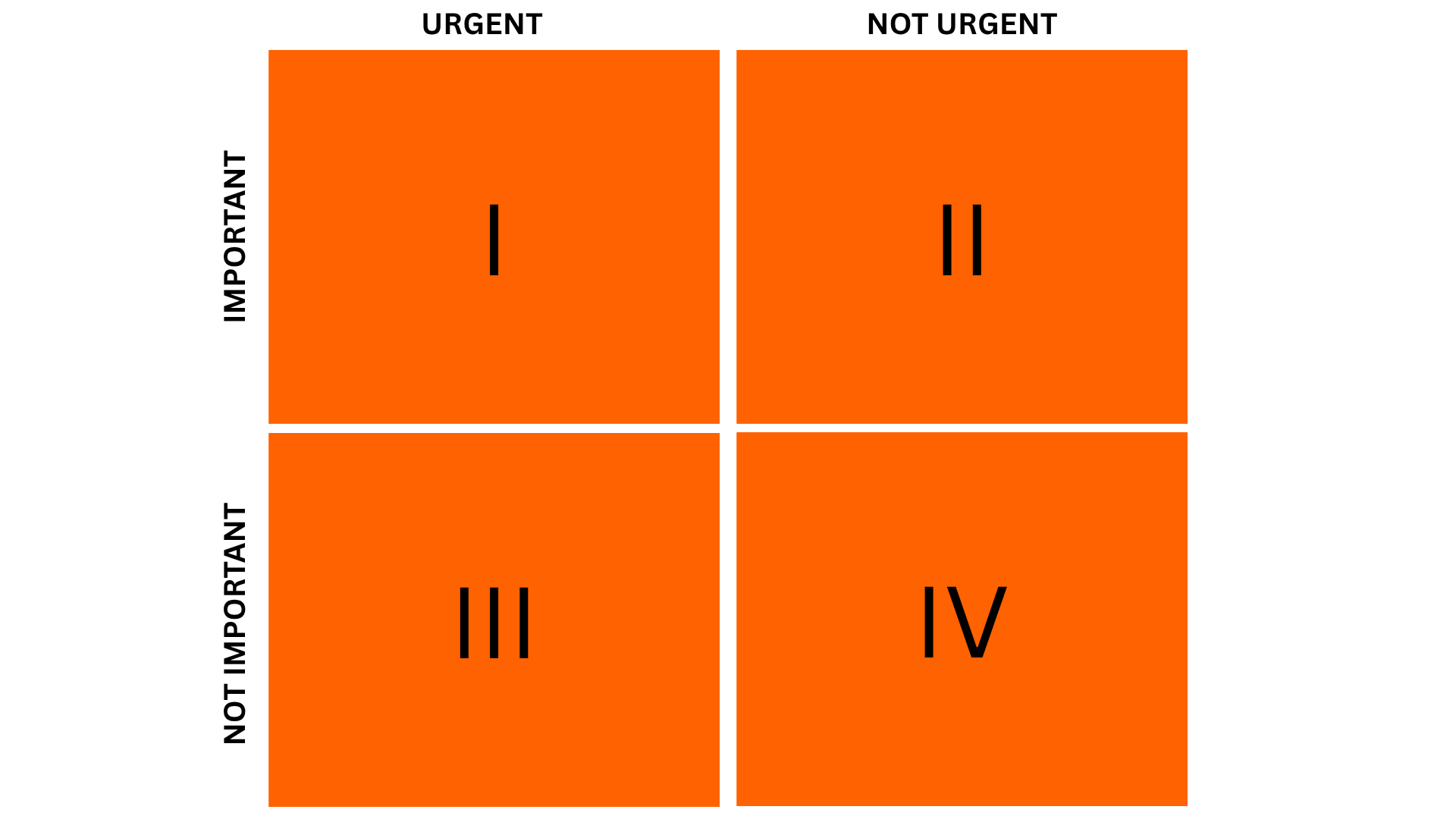
The matrix has four quadrants: urgent and important, not urgent but important, urgent but not important, and not urgent and not important.
Most business owners live in the urgent quadrants. They’re putting out fires all day. A client emails with a problem. Urgent and important. An employee needs help with something. Urgent and maybe important. Social media notifications. Urgent, but definitely not important.
But here’s the secret. Wealth is built in the not urgent but important quadrant. This is where you do strategic planning. It’s where you build systems. It’s where you create content that brings in leads next month. It’s where you develop relationships that turn into partnerships. It’s where you actually create the assets that build your wealth.
Most business owners know that the quadrant exists, but they never actually schedule time for it. They think they’ll get to it when they have time, but you’ll never have the time unless you make the time.
The business owners making serious money, well, they schedule non-negotiable blocks of important but not urgent activities. Two hours every Tuesday morning for strategic planning. One hour every Friday afternoon for relationship building. Three hours every Wednesday for system building. They protect this time like their life depends on it because their business success does depend on it.
But here’s what they do differently. They don’t just block the time. They get specific about what’s important but not urgent and what they can actually do to move their business forward by focusing on that important but not urgent work. And that’s where inputs come back into play.
The $100k Input Method Formula
So we can make this practical. This is where the rubber meets the road. The $100,000 input formula is not complicated, but most people skip the math. And if you skip the math, you’re just guessing.
Start with your revenue goal. Let’s say it’s $25,000 monthly recurring revenue, like my automation agency example. Don’t just write that number down and stop there and hope. Instead, you start there and then you work backwards.
First, you figure out your price point. Could you get $25,000 from 10 clients paying $2,500 each? Or would you rather have 25 clients paying $1,000 each? Or maybe five clients paying $5,000 each? The math changes everything about your strategy. It helps you determine what value you can offer and where your focus should be.
Personally, for my automation agency, I chose 10 clients at $2,500 a month because I knew I could deliver serious value at that price point.
But here’s where most people stop. They think the goal is to get 10 clients. Wrong. That’s still an outcome.
The real question is this: how many qualified prospects do you need to talk to in order to close 10 clients? If you close 10% of qualified prospects, you need to talk to about 100 people. And that’s an input you can control.
But it goes deeper. How many leads do you need to generate in order to get 100 qualified prospects? If 3.5% of your leads become qualified prospects, then you need about 3,000 leads. Now we’re getting somewhere.
Your real daily goal isn’t $25,000 in revenue. Your real daily goal is activities that generate 100 leads: making cold calls, sending connection requests on LinkedIn, publishing content. These are inputs that you can control completely.
When you know your numbers, you know exactly where to focus. If you’re not hitting your revenue goals, you can trace it back. Are you not generating enough leads? Is your conversion rate from leads to qualified prospects too low? Are you not closing enough of your qualified prospects?
Most business owners are trying to fix problems they can’t even see. But when you track inputs, the bottlenecks become obvious. And when the bottlenecks are obvious, the solutions become clear.
From Outcomes to Inputs
I hope you don’t just read this and move on. I hope you take time to actually determine your math and what your inputs should be.
Most business owners are stuck tracking the wrong metrics. They’re focused on outcomes that they can’t control instead of inputs they can control completely.
The Eisenhower Matrix actually shows where real wealth gets built. It’s not in the urgent quadrants where most people live, but it’s in the important but not urgent quadrant. And that’s where you create systems, you build relationships, and you plan strategically.
And the $100,000 input method gives you the formula. You work backwards from your revenue goal to your price point to your conversion rates. You figure out exactly how many leads you need and what activities you need to do to generate those leads. Then you focus on those activities.
When you make the shift from hoping for outcomes to controlling inputs, everything changes for you. Your day becomes clear, your focus becomes sharper, and your results become predictable. You see your bottlenecks and know where your focus needs to go.
The conversation
0 comments
No comments yet. Be the first to share your thoughts!
Leave a comment